Showing posts with label guns. Show all posts

Saturday, December 27, 2014

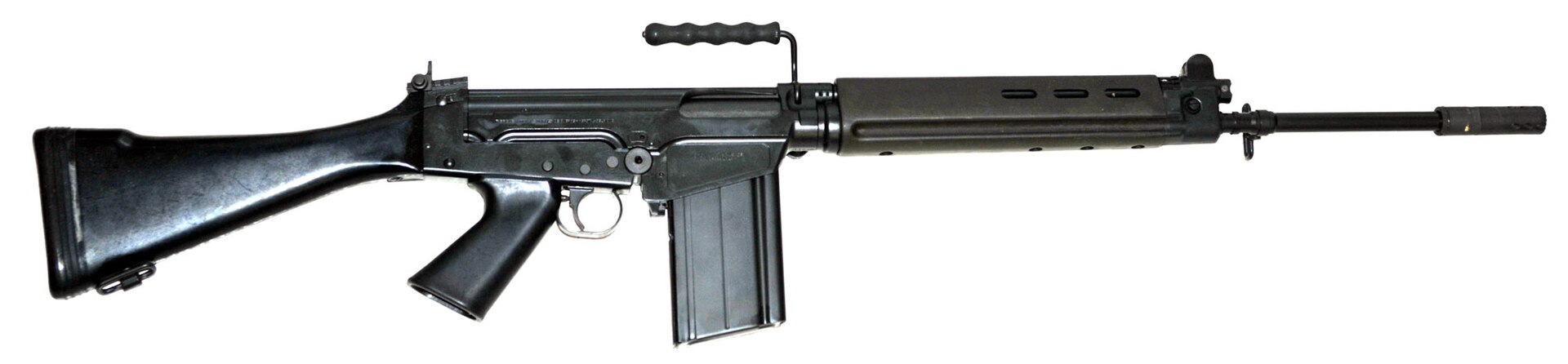
Book Review: "The FN FAL Battle Rifle"


When I received a signed copy of my brother Bob's latest book "The FN FAL Battle Rifle," a book about the Cold War rifle known as the "right arm of the Free World," of course I was excited to read it.  Bob is a former active duty Cavalry Scout, Desert Storm vet, forestry worker, and still an avid shooter and gun collector living in Montana. Suffice it to say he has a passion for firearms and military history.


Since I'm not quite the firearms technician nor military historian that my brother is, part of me was a little worried I might find parts of a "biography" of a rifle a little dry. However Bob kept the book quite interesting and accessible to us laypersons while still providing plenty of detail for gun wonks.


For many American gunnies the Cold War was a face-off between the American M16 and the Soviet AK-47. However the 7.62x51mm NATO Fabrique Nationale (FN) Fusil Automatique Léger (FAL) eventually equipped over 90 Western nations around the world, earning it the aforementioned nickname. The history of the FAL is a history of every bushfire war that popped up during the Cold War. The FAL showed up in most of them, officially or not. The FAL's storied history reaches a crescendo during the 1982 Falklands War where both sides (the British and the Argentinians) used the FAL against each other. Bob's book chronicles the whole history.


First Bob walks us through the development of the FAL right after WW2. Besides the technical aspects of developing the new weapon there was the political quarreling behind adopting a new NATO standard rifle round. The book then provides a brief rundown of the adoption and modifications made by each of the major nations issuing the new FAL. There is a section running down the major accessories adopted for the FAL including magazines, optics, rifle grenades and bayonets.


In the next section Bob points out that although the FAL was (thankfully) never used for its intended role of repelling a Soviet invasion of Western Europe, "[i]t did, however, give excellent service in battle around the world in many smaller wars and numerous insurgencies." Bob gives a brief history of the FAL's major use in combat by the British army from the 1948 Malayan Emergency to the 1991 Persian Gulf War and by other nations in African and Latin American bush wars, the Arab-Israeli Wars, the Indo-Pakistani Wars, and Vietnam. The FAL still pops up in combat zones today.


The book then has a breakdown of the capabilities of the FAL's 7.62x51mm NATO cartridge as well as an analysis of the strengths and weaknesses of the FAL system itself. Bob also compares and contrasts the FAL with its two a main contemporary rival battle rifles the German G3 and American M14. The book is chock full of historical photographs, graphs, as well as several original historical battlescene paintings created specially for the book by British artist Steve Noon.


I thoroughly enjoyed taking the stroll down Cold War "memory lane" that "The FN FAL Battle Rifle" provided. I think anyone with a bit of interest in weapons and/or military history will enjoy it as well. I recommend you check it out.

Thursday, July 10, 2014

Black Rifle (Bam-Ba-Lam)

Semi-automatic rifles, variously called "sport utility rifles," homeland defense rifles," or "modern sporting rifles" by those who enjoy and support their use, and often derisively labeled "assault weapons" by those who wish to ban them, are among the most popular guns on the market today. The AR-15 style weapon is the most popular among them. Americans own about 5 million ARs with about 500,000 more hitting the private market each year.


With numbers like that there should be plenty of gun owners in need of training on how to maintain and safely shoot the AR platform. Recognizing this market, Corey D. Roberts and the rest of the crew at Tactical Insights LLC defense training have stepped in with their new "Black Rifle" Operator Course. Since the stated goal of the class is to "provide skills and knowledge to every student, from the new rifle owner to the experienced shooter" I decided to sign up for the class.  The debut class was June 7th.


Most of the 14 or so people in the class had .223 caliber M4-style ARs with 16" barrels and collapsible stocks. There were two oddballs. One guy had an AK-47-style rifle and I had a full-size .308 caliber AR with 20" barrel and solid stock. Thankfully nobody engaged in any Freudian speculation on why I needed the big battle rifle. (I'm just taking the advice of Boston T. Party, Fred, and Bob Cashner. Honest!)


The first three hours of the class were in the classroom. Roberts and Ryan Evans, a police officer and certified armorer, headed the class. There was an overview of the AR-15 and AK-47 systems, with definitions, capabilities and explanations of their respective ballistics. Students were walked through field-stripping their weapons followed by some shooting fundamentals. All in all the classroom section of the class was a good "basic training" for AR owners.


The next five hours were on the shooting range. Students practiced shooting from various standing, kneeling and prone shooting positions that one doesn't always see at the shooting range. We shot at moving targets, from under and around barricades and practiced shooting while on the move. It was a good day of practice using the AR platform in close quarter battle drills.


I thought the class was a great learning experience sure to provide new AR-15 owners and seasoned shooters with increased proficiency. If you've got a "black rifle" you might want to check it out.

Thursday, April 3, 2014

"Cold Hard Cashner on Gun Rights"

Please check out and buy my new book: "Cold Hard Cashner on Gun Rights: Second Amendment Writings From 2008-2013."
http://www.blurb.com/b/5203508-cold-hard-cashner-on-gun-rights
 
"Cold Hard Cashner" has been called "the premiere small-town Iowa blog about Liberty." This book collects the blog's best posts dealing with Second Amendment issues since its inception in 2008 through 2013. In these pages you will read about the history and philosophy behind the Second Amendment, Iowa's struggle to become a "shall-issue" state, gun training and selection, and the gun politics in the state.

About the author: Benjamin R. Cashner is a lifelong resident of Iowa where he lives with his wife and two children. He served as an infantryman in the Iowa Army National Guard from 1992 to 1998. Cashner is a member of the Iowa Libertarian Party and his columns have appeared in the "Cedar Rapids Gazette" and "Iowa City Press-Citizen."

Buy the book HERE.

Thursday, June 27, 2013

Adventures In Gun Training

"Survival isn't about stuff. It is about skills. If you have time and just a bit of money, then you can get some very well-rounded training in skills that are quite applicable to [survival] living." So says James Wesley, Rawles in his national bestseller How to Survive the End of the World as We Know It: Tactics, Techniques, and Technologies for Uncertain Times. Of course it doesn't have to be the end of the world for some firearms training to come in handy. Studying National Crime Victimization Survey data, criminologist Gary Kleck found that “robbery and assault victims who used a gun to resist were less likely to be attacked or to suffer an injury than those who used any other methods of self-protection or those who did not resist at all.”

I knew that my pistol skills have never been finely polished, so I decided to take Mr. Rawles advice and get some training. I've always enjoyed shooting rifles and trained on them in the Guard, but handguns have always kind of been an afterthought, even after I got my Iowa permit to carry weapons back in 2009.

I discovered Tactical Insights in Monticello when I took one of my sons to the Eddie Eagle Children’s Gun Safety Course that they put on in our town in January. Later I interviewed the owner, Corey D. Roberts, for my blog. [You can read Roberts' thoughts on various Second Amendment issues here: Interview Part 1 and Part 2.] When I read about their class Tactical Shooting for the Private Citizen Level 1 it sounded like just what I needed.

"[T]his course begins the transition of the shooter from a 2 dimensional world of putting holes in paper, to truly using a tactical mindset making the firearm a weapon and a tool," states the course description. All my previous pistol practice had been comprised of static target shooting. My permit to carry class dealt mostly with the legalities of carrying and Iowa self-defense law. I signed up and couldn't wait to learn some realistic defensive shooting tactics.

Roberts started the Tactical Shooting class with the basics. After a safety briefing he went through the fundamentals of gripping the pistol and stance. As it turned out, the "redneck shooting at cans" stance and grip that I had previously taught myself was less than optimal. I now had to unlearn those bad habits.


Roberts demonstrates a shooting drill.
After teaching a boatload of other pointers we were soon out on the range. Although we started out slow, the shooting was no mere standing and shooting at bulls eyes. For tactical shooting you have to move to keep the threat from getting a bead on you. Even simple shooting drills got the heart going. Before long we were shooting on the move.

Not only was I able to put myself through the paces, but my equipment as well. My old 1911 .45 pistol was found lacking. Roberts had said that he'd never had a 1911 shooter make it through one of his classes without having malfunctions. I did not change that streak. I also spent a lot of time fumbling with my safety, etc... Finally, once when I slapped a new mag into my .45 the floor plate busted right off the mag, sending ammunition and the mag spring launching onto the ground.

Corey took pity and let me borrow his .40 Glock 22 for the remainder of the class. I loved it! It performed flawlessly and was very simple to use. Although my gun budget is nearly nonexistent, I think my next purchase will have to be a Glock. (I think I'd prefer the smaller Glock 27 for concealed carry, if anyone is looking for a birthday present for me.)

Tactical Shooting for the Private Citizen Level 1 was supposed to be just pistol shooting. But since we were a very small class and since Roberts and his instructors didn't have to spend an exorbitant amount of time on, what they called, the "stop pointing that at me" portion of the class, we got to do a few things that weren't on the syllabus. We got to run a few three-gun drills with pistol, shotgun and carbine as well as shoot a few other weapons that the instructors brought in.

The author gets familiarized with the
Israeli Tavor rifle.

All in all I found the class very instructive as well as great fun. I absolutely learned more in eight hours than I ever did in a year's worth of Guard drills (and fired about three times as much live ammo). I left with many new techniques to practice at home and at the range as well as with a nicely illustrated study guide to take home and review when needed. Although I still consider myself a rifleman at heart, this class increased my confidence and competence with handguns immensely. It was well worth every penny.

If you're one of Iowa's growing legion of permit-to-carry holders or you just have an interest in defensive shooting and you want to move from "a 2 dimensional world of putting holes in paper, to truly using a tactical mindset making the firearm a weapon and a tool," then I recommend you find a Tactical Insights training course that fits your needs and take it.  Check them out here:
 
Photos courtesy of Tactical Insights L.L.C.

Saturday, February 23, 2013

10 Questions with Corey D. Roberts (Part 2)

Continued from Part 1.

Corey D. Roberts is the founder of Tactical Insights L.L.C. in Monticello, Iowa, which provides "Christ-Centered Emergency Response Training" for churches and faith based organizations as well as tactical training for law enforcement and private citizens.

Roberts is currently a full-time patrol police officer with the Monticello P.D. and also serves on the multi-jurisdictional Jones County Emergency Response Team as Tactical Commander. He also serves in the Iowa Army National Guard (having served as an enlisted man, NCO and officer) and has been deployed several times.

Officer Roberts agreed to answer a few questions for me about guns, crime and freedom. The views expressed are those of Roberts and not necessarily those of any organization he may be affiliated with.

6. Sen. Dianne Feinstein, D-Calif., introduced a bill that would ban "assault weapons" and “high capacity” ammunition magazines. Says Feinstein, “Military-style assault weapons have but one purpose, and in my view that’s a military purpose, to hold at the hip, possibly, to spray fire to be able to kill large numbers.” You are intimately familiar with weapons like the AR-15 (which would be affected by the ban). What exactly is an "assault weapon?" Do you agree with Feinstein's analysis of the purpose and proper employment (such as being designed to be "spray fired" from the hip) of weapons like the AR-15?

            Sen. Feinstein watches too much television.  I will begin by answering the basic question of “What is an Assault Weapon?”  To be perfectly honest, as a firearms expert, I don’t know.  The term “Assault Weapon” is not a gun term, it is a political term that is used to scare people.  The term “AR” does not stand for assault rifle.  It stands for Armalite, which is the company that produced the modern civilian model of the gas operated, magazine fed, semi-automatic sporting rifle.  Armalite developed the AR-15.  Having been in the military for 20 years I can say without question that no one is taught to “hold at the hip and spray,” certainly not with the black rifle that she is comparing to the civilian semi-automatic rifle.  Currently our military is issuing an M4 which is similar in design to the civilian model, but functions differently.  Even our military does not issue “spray and pray” weapons.  The current issued M4 is not fully automatic and instead uses a 3 round burst mode.

This argument has nothing at all to do with banning a specific firearm.  These terms such as “high capacity magazines” and “Military style assault weapons” are being used to divide the gun enthusiasts in this country.  The liberals who wish to confiscate our firearms understand that they cannot simply say that they are going to ban firearms, they have to start slowly.  If they can convince the hunters and collectors in the country that the only “bad guns” are the “assault weapons” it sounds reasonable, and people want to be reasonable.  They are working to convince the guy with the shotgun that he has nothing to fear and that no one “needs” 30 rounds.

As an aside, I mentioned that we have begun to define all of our needs as rights, so why are we surprised when the government begins to infringe on our rights based on need?  I disagree with the premise that our rights are defined by need.  The argument that I have used is that if our rights are based on need, then please explain to me the need for Rosa Parks to sit in the front of the bus.  It was her right, not her need.

Our government has developed a pattern that is easy to follow if we pay attention.

 Step 1. Create a term that everyone can agree is bad.

Step 2. Refuse to define said term but continue to use it and enlist the media to join you in using it.

Step 3.  Wait for a critical incident in which said term can be applied and the “people” cry out for government intervention.

Step 4:  Create your own definition for the term.

For example, our government uses the term “assault weapon” and even uses the term “reasonable” when attempting to convince the American people that no one needs them.  The media then splashes the term “assault weapon” only when describing a weapon used by a crazed gunman and never when used by anyone else.  A great example of this was the Dorner case in California in which one media outlet used the term “assault weapon” when speaking of Dorner, but used the term “personal defense weapon” when talking about the exact same weapon used by law enforcement in the same article.  When confronted about the definition of “assault weapon” the government uses another non-definable term to define it, “military style”.  So, we have the media and the citizens agreeing that “assault weapons” are bad, but when the ban list comes out from Sen. Feinstein, we see that she is actually referring to any weapon with a detachable magazine and any weapon with a pistol grip.  But by now the media frenzy has convinced the people that the government is only after “assault weapons”.

Some other examples of this government pattern is the use of the term “universal background check”.  Again this term has been championed as “reasonable” but has yet to be defined.  “Mental health assessment” has been spoken of as a “reasonable step” to curb gun crime, but has not been defined.  Questions for those who support the Universal background check and Mental health assessments are as follows: Will the government maintain a record of every citizen who had a background check to pass family heirloom rifle to their children?  What parts of the “background” is involved?  Will this background check be compared to any “watch lists”?  (The DOJ stated that combat veterans should be on a watch list.)  Who will receive a “mental health assessment”?  At what age will we begin to “classify” our citizens based on this assessment?  (People are very different at 16, 22, and 35.)  Who will be deciding what is mentally “fit”?  Does marital counseling bring into question whether a person is mentally “fit?  What about “sexual deviancy” (remember homosexuality was a diagnosable mental condition)? What is to be done with those “classified mentally unfit” persons? 

Can you see where these questions are going?  I follow the rule that anytime the government uses the term “reasonable”, I begin to question it right away, governments are anything but reasonable.

When we allow our government to infringe on our rights based on terms that sound scary such as “domestic terrorist,” we all agree that “terrorists are bad and should be killed.”  The problem is that the government’s definition of “terrorist” can be re-defined to mean anyone who the government sees as a threat. 

The 2nd Amendment was specifically put in place to ensure that the people had the power and the government did not.  Those who believe that only the military and police should control the guns, or that only they should have the most recent technology in firearms must also agree that only the government should have control of the media and internet.  Our government is very aware of the power of an armed populace and shows it by arming citizens all around the world to overthrow their own governments, such as Egypt, Lybia, Syria, Afghanistan, etc.  I do not trust a government that wishes to disarm its own population.

Make no mistake, this gun legislation has never been about guns, it’s been about control and many in our government have been waiting for just the right catalyst to push the agenda.  

Limiting “high capacity magazines” is another example of this erosion of rights.  My first question to anyone advocating this is “Please tell about all the firefights that you have been in that led you to the conclusion that people only need 7 rounds?”  Who does this “limit” hurt?  An active shooter by statistics will bring multiple weapons, multiple magazines and lots of extra ammo.  The free citizen who is carrying a firearm is the only one allowed a limited number of rounds.

This free citizen has not planned to be in a fight for his life today, the crazed gunman has a plan.  The citizen is required to respond to a well-planned, prepared for attack with whatever he has on his person.  Will the limit on magazines affect the preparedness of the crazed shooter?  Of course not, it will simply make it harder for the citizen to defend him or herself.

7. Your website includes a statement of faith and says that you "felt a strong call of God to minister to the local church in matters of Emergency Preparation, Response and Training." It's obvious that your Christian faith is central to your life. Some Christians, however, wouldn't touch a gun with a ten foot pole. They would cite Christ's instruction to "turn the other cheek" or the Sixth Commandment. According to the National Council of Churches ofChrist, U.S.A., "Christian tradition insists that it is idolatry to trust in guns to make us secure, since that usually leads to mutual escalation while distracting us from the One whose love alone gives us security." How do you square your Christian faith with the potential deadly force of firearms?

We believe that a Christ-Centered Security Team is a group of Christians who desire to apply a Tactical Mindset to serve God and their local church through preparedness and willingness to respond in event of an emergency.  I have a lot of respect for the National Council of Churches of Christ but I tend to disagree with many of their stances on several issues. 

Their stance based on “Christian tradition” is well meaning but does not address the realities of the Bible. Our security for our ministries should be based in faith and managed in action.

While we embrace the biblical teaching that God will provide our needs and we believe the Bible when it says in Matthew 6:25 “Take no thought for your life, what you shall eat, or what you should drink; nor yet for your body, what you should wear,” this faith and confidence does not remove us from participating in our own preservation.  Christ was not telling us to stand around waiting for food to fall into our mouths, or water to just appear.  We do not stand in our bedrooms in the morning and wait for clothes to float out of the sky and land on us.  These require action on our part.

Nehemiah 4:9  “We prayed to our God and posted a guard…” 

Isaiah 62:6- I have set Watchmen on your walls, O Jerusalem; They shall never hold their peace day or night.

Nehemiah 4:9-…because of them we set a watch against them day and night.

John 15:13  “Greater love hath no man than this, that a man lay down his life for his friends.”

Luke 10:19- Behold, I give you the authority to trample on serpents and scorpions, and over all the power of the enemy.

Luke 22:36-…and he who has no sword, let him sell his garment and buy one.

1 Peter 5:8- Be sober, be vigilant; because your adversary the devil walks about like a roaring lion, seeking whom he may devour.

Romans 13:4- For he is God’s minister to you for good.  But if you do evil, be afraid; for he does not bear the sword in vain; for he is God’s minister, an avenger to execute wrath on him who practices evil.

In 2012 alone, there were 135 total deadly force incidents in churches and ministries alone and this number is increasing every year.  We have taught Response to Active Shooters both armed and unarmed.  This choice is as personal for a Christian as it is for any other citizen.   

While I may disagree with many things that the National Council of Churches of Christ, U.S.A. believes I firmly stand with Philippians 1:15 “But what does it matter? The important thing is that in every way, whether from false motives or true, Christ is preached. And because of this I rejoice.”

8. If talking to someone who was new to guns and was looking to purchase, what weapons would be your top picks for concealed carry and for home defense and any other category you think relevant?

Rule 1: ignore the hype. Every "gun guy" out there will be more than willing to give you advice on the perfect weapon/caliber/cool guy gear out there. I would stick with a reputable manufacturer. Think simple, especially for a defensive weapon. If it requires buttons and switches and voodoo spells to fire...it's too complicated.

Also don't buy the hype of "knock down power" and buy a huge caliber. For one, it will be more expensive to shoot and two if it's not easy to shoot, you won't shoot. I use the analogy that if someone were to give me a 20,000 dollar set of golf clubs, I would chase that stupid little ball through the trees all day the same I would with a 60 dollar youth set from Wal-Mart.

Proficiency requires practice. A well placed set of rounds from a 9mm or .40 caliber will do the same as a .45...good guy wins, bad guy loses. With the current advancements in AMMO, the old argument of Big Caliber=One shot stop is gone. This isn't TV, it's not high noon and people don't fly across the room when shot...even with a .45. I personally would not go smaller than 9mm but I really prefer the 9mm.  Higher ammo count, less recoil, less weight, awesome power with good ammo.

On the other side of that argument, a .22LR that one is willing to carry is more effective than a hand cannon at home or in the glove box.

I would suggest getting an idea of what you are looking for:
Am I going to carry it every day?
Is it easy to operate?
Can I conceal it?
Is ammo easy to acquire for it?
How much do I want to spend?
Will I enjoy shooting it?- Only practice makes proficient
Will it work under the worst possible conditions?- Murphy's Law.

I would suggest looking at the Glocks, Smith and Wesson M and P's or Sig Saur. For small carry guns Khar makes some very nice pistols.  One way is to hit up a local gun club and talk to people. 74% of law enforcement carry Glock and the majority carry one of the other two. The reason is simple...they are proven, no gimmicks, no "latest greatest", just a solid combat pistol that will operate when needed.

There really isn't a trick to it, which is why I offer people to shoot different stuff (anything I have) at my classes. Unfortunately there aren't a lot of people that will allow that. I carry a Glock 22 .40 caliber on duty, a Sig 229 .40 caliber on the SWAT team and a Glock 26 9mm off duty. My wife Jeannine carries a Glock 19 9mm. We have been very happy with them. I also occasionally carry a .357 revolver and have no problem with it other than low round count.

Cost is going to be an issue because of the buying that is going on ahead of Congress making some possible moves. You should look to spend $350-$600 on a good quality handgun. For a convenient carry pistol, I would also suggest looking at the Beretta Nano (it's a 9mm). I have just started carrying it so I can give other ideas for people who "don't want a Glock" and I have been very happy with it. It runs about $360.00.

I have nothing personally against the big 1911.  45's other than the ones manufactured today have a VERY strong emphasis on accuracy, which is why you see the competition shooters using them. The way they get this is by making the guns tolerances VERY tight. This leads to problems with functioning in a defensive "combat" pistol role. I have NEVER had a 1911 shooter make it through one of my classes without having malfunctions. When they get dirty, they begin to have issues. Not a problem on the range...BIG problem for defense. Of course, you also run into issues with concealability with the big 45s.

Choosing a handgun is as close to purse shopping as we can get. It has to work for you. Just because some "expert" says that some brand is the "best" or some caliber is the "must-have" does not make it true.  You need to pick it up and hold it.  If it feels wrong in your hand, you probably should keep looking.  Ideally, you should shoot that make and model before buying it.

For home defense, I prefer the 12 Gauge shotgun with a “pirate grip” and a side saddle with extra rounds.  Very little will discourage an intruder more than the sound of a pump action shotgun.  If that is not enough to discourage them, the first round will certainly help convince them.  Another reason I prefer it is that I can choose the round that I wish to have in it.  I use target load as the first several rounds in order to eliminate over penetration in my own home.  I have double 00 buck and slugs in the side saddle if needed.  The home defense weapon should be part of a total home defense plan that includes physical security, phones in appropriate rooms and practiced drills. 

The reality is that just because a gun is really cool and effective in Call of Duty does not make it a practical choice for self-defense. 

9. You and I are about the same age. In addition to having a lovely family, you’ve amassed significant civilian, military and law enforcement training. You’ve authored a book and numerous articles. You’ve racked up real world experience on the streets at home as well as serving in Kosovo and Afghanistan and even fighting wildfires in Montana. In contrast, aside from two wonderful sons, my only accomplishment has been to collect all five seasons of “Quantum Leap” on DVD. What is your secret for accumulating such a wide breadth of experience before you’re even forty?

 I distinctly remember a conversation with my Dad that night before I left for Army Basic Training at the age of 17.  During this conversation my Dad told me to ignore those who lived by the rule “Don’t volunteer for anything” and to take every opportunity for a new experience.  I have followed that advice in every area of my life.  While there were times that volunteering caused me to do tasks that I did not enjoy, more often it afforded me the chance to do something amazing. 

Colossians 3:23 says “Whatever you do, work at it with all your heart, as working for the Lord, not for men…”  I don’t know the trick to being driven.  I do credit my upbringing and the example of my father.  Were I to give a young man advice, I would simply say, “Volunteer for everything.  In every task you have, work to be the best at it.  Learn from those who have gone before.  Accept responsibilities that are given to you and do them to the best of your ability.”

Years ago during Army Officer Candidate School, I was selected as the “Kai-Bo Commander”. For those that do not know what a Kai-Bo is, they are also called Port-a-Johns or any other inappropriate names that one can think of.  I was in charge of the plastic toilets just like the ones at construction sites. To say the least, I was not impressed with my assignment. My job was to ensure that the toilets were reserved, delivered and placed at the various training sites where we would be conducting field operations.  The position I felt I deserved was that of Class Commander, or at least a Platoon Leader, but no, I was Candidate Roberts, “Kai-Bo Commander”. This was obviously not my proudest moment.

I decided that if someone had to do it, then I would be the best Kai-Bo Commander the Army had ever seen. Don’t be fooled, this didn’t make my job any less demeaning, or any more glamorous. What it did do was show my superiors that I was willing to take the task and do it to the best of my abilities.  The happy ending to the story is that after a short time, I was taken off of Kai-Bo duty and given a position that I felt was much more in line with my desires.

When you are given a task, do it to the best of your ability every time. Even if it is not the duty you want, take the small steps.  The Bible has a parable of a rich man who was traveling and left his servants with some money.  To one servant he gave ten, to another five and to the final two.  When he returned, he asked the servants what they had done with the money and the one with ten said, I invested it and made ten more. The rich man gave him control of ten cities.  The servant with five said I invested and made five more. The rich man gave him control of five cities.  The final servant said, I kept the money and did nothing with it. The rich man called him a wicked and slothful servant and took the two away from him and gave it to the one with ten. ~Matthew 25:14-30

The simple point to his story is that when given more, more is expected. Prove that you can handle the little things and you will be given greater and greater responsibility.  When you are put in charge of small tasks, do them as though they are the most important task that can be had. Show your willingness and ability to accept those challenges and you will be given more responsibilities.  Fail in the small tasks, and it will be understood that you will fail at the big tasks.

10. Lastly, who do you think would win in a gunfight, the overzealous Sgt. Eugene Tackleberry from the movie “Police Academy” or survivalist gun nut Burt Gummer from “Tremors?”
 I would have to go with Burt.  While I love Tackleberry’s drive and his affinity for guns, Burt has spent his life preparing.  A fight is always won before the first punch is thrown, before the first shot is fired.  Those who have developed a strong Tactical Mindset have a marked advantage.  I believe that all of us can and should have a Tactical Mindset.  We begin to develop this the day we realize that we are being hunted.  When we can understand the threats around us we can begin to develop the “when this-then what” preparedness that life requires.  Burt was prepared for giant worms in the ground, which tells me, he is prepared for pretty much anything
Saturday, September 4, 2010

Be Prepared. Be Armed.

[A note from Ben: I've posted this same post every September since I've started this blog. Since much of it is still relevant, I decided to post it again this September. I hope you'll indulge me yet again.]

After a year replete with blizzards, tornadoes, and epic floods, we Iowans now realize that disasters don’t just happen to those people on the coasts that we see on TV with their fancy earthquakes and hurricanes. So Iowans should sit up and take notice that September is “National Preparedness Month.”

The U.S. Dept. of Homeland Security’s (DHS) “Ready Campaign” recommends three things to prepare for disaster: 1.Get a Kit, 2.Make a Plan, 3.Be Informed. The "Be Ready Iowa!" website has a pretty similar list you can check out too.

Since you can read the details at the National Preparedness Month website, I won’t rehash what each of these entails. But I will spend some time on one vital survival tool that usually doesn’t make the government’s list: a modern firearm.

I won’t try to sell you on owning a gun if you don’t want one. I fully support your right to NOT own a gun. However, I’m convinced now more than ever that a firearm is an important part of an American’s readiness kit.

During Hurricane Katrina we saw massive destruction that stripped all credibility from the modern argument that you can just call 9-1-1 in an emergency. When the phones don’t work and the police themselves are looting, who do you call and how?

During the 1992 Los Angeles riots the California National Guard arrived on the scene without any ammunition and missing their riot gear. When the local cops and state militia can’t impose order, who do you call? Local Korean shopkeepers were more prepared and defended their businesses with semi-automatic rifles until the Marines showed up to quell the riots.

Even in less extreme circumstances, Americans use firearms in self-defense over 1 million times each year. (Some research puts that number at 2.5 million times per year.) Usually the defender doesn’t even have to fire a shot before the attacker runs off to look for easier prey. A gun is a useful defensive tool.

I’ve been a lifelong shooter, but I don’t consider myself an expert. I’m someone who wants a functional weapon for protection and recreation, but who doesn’t have the time or money to make a religion out of it. I write the following pointers for people who are considering buying a defensive arm. It should not be considered technical nor legal advice, nor anything else that will get me sued. If at all possible, take a gun safety class and certainly check to make sure you are complying with all state, local and federal laws and regulations. Chat with shooters in your area.

Guns that shoot .22 rimfire ammo are good for target practice and small game but are generally too underpowered for defensive purposes. Get the largest caliber that you can comfortably handle. Stick with common calibers so that ammunition will be relatively plentiful and cheap. If you live in close quarters with others, consider buying frangible ammo by MagSafe or Glaser. It breaks apart on impact rather than punching through the wall into your kids room or the neighbor’s sitting room. (Definitely not the way to get invited to the next apartment block-party.) Frangible ammo is costly so practice with cheap “ball” ammo and save the frangible stuff for defense.

The kind of gun you choose will depend on what you're trying to defend.

Level One-Defending Yourself: Being lightweight and concealable, the handgun is the ideal weapon for defending your person. Here in Iowa you’ll need a special permit to buy one and another special permit if you intend to carry your pistol in public. Both are available from your county sheriff.

Semi-automatic pistols are the most popular, but are generally more complicated than revolvers. Glock (brand) pistols have a reputation of ease of use and reliability, but they are costly. The .45 caliber M1911 has proven reliable enough to still be popular almost 100 years after it was invented. (This is what I carry.)  Avoid the very cheap “no-name” autos; you get what you pay for. Common calibers for auto pistols are: .380 ACP, 9mm, .40 S&W, and .45 ACP.

Revolvers are rugged and reliable. There’s darned little that can go wrong with them. The down-side: They usually only hold six shots. Stick with "double-action," as opposed to "single-action" revolvers. Common calibers are: .38 Special, .357 Magnum (revolvers chambered for .357 Magnum can also shoot .38 Special Ammo, but not vice versa), .44 Magnum and .45 Colt.

Level Two- Defending Your Home: Your pistol will make a fine home defense weapon, but since size and concealability won’t matter on your own property, you might want more gun. A shotgun or small-caliber carbine rifle would make a good home defense weapon. No special permit is required to buy long guns in Iowa, but the retailer will run a criminal background check on you at the point of purchase.

Shotguns fire a number of small metal balls rather than a single bullet. Contrary to popular belief, you still have to aim. “00 Buckshot” is the most powerful ammo but in close-quarters you may want 6 or 7-½ birdshot to avoid over-penetration. A pump-action shotgun should be reliable enough. Common calibers are: .410, 20-guage, and 12-guage.

There are numerous pistol-caliber carbines out there that work well if you need just a little extra “reach,” such as on a farm. (If you're on a budget, Hi-Point Firearms makes a very affordable pistol-caliber carbine.) The old M1 Carbine is also readily available. Again, consider frangible ammo if you have neighbors very close. Common calibers are the same as for handguns and .30 carbine ammo for the M1 Carbine.

Level Three- Defending Freedom: If you live in open country or for the real doomsday (and less likely) scenarios involving extended anarchy, invading armies or the four horsemen of the Apocalypse, you’ll need a rifle. You might want one anyway, because they’re fun to shoot. If you don’t already have a bolt-action or lever-action that you’re comfortable with, get a reliable semi-automatic.

A .223 caliber rifle should be your bare-minimum for defense. Common semi-automatic weapons in this caliber include the AR-15 (by many names, from many manufacturers including one made in Iowa), Ruger Mini-14, and the Kel-Tec SU-16 to name just a few. There are also many semi-autos chambered for the 7.62 X 39mm Russian round. These include the AK-47, SKS, and Ruger Mini-30.

If you can handle the extra kick, the .308 Winchester round gives better range and take-down power than the two previous calibers. The most common semi-autos in this caliber are the Springfield M1A, AR-10 clones from several manufacturers, FAL clones, H&K 91 and the Israeli Galil (also available in .223).

You may want to configure your rifle as a “scout rifle.” With a small, low-powered telescopic sight mounted far ahead on the weapon, it becomes much easier to quickly acquire and engage targets at normal combat distances. [Shameless plug: To inexpensively configure your weapon read the newly revised and updated “Poor Man’s Scout Rifle” by my brother Bob Cashner, who, unlike me, is an expert.]

Besides the three mentioned above, two other common rifle calibers are the .30-30, which is common in lever-action rifles, and the .30-06, which is fired through the semi-auto M1 Garand rifle as well as many bolt-actions.

There you have it, firearms for any scenario. If you get one, learn to shoot, maintain and store it safely. (For gun safety classes try here or here.) Remember that your gun will do you no good if you don’t have any ammo or if its rusted shut. Whatever weapon you can afford is better than no weapon at all.

In honor of National Preparedness Month: Be prepared. Be armed.

Wednesday, March 31, 2010

The First TING's of Spring

What a beautiful day in Iowa! It was 77 degrees when I got off work. (Thank you global warming!) My wife and kids weren't home when I got there, so I decided to head down to the local shooting range.

I shoved my homemade steel silhouette target in the trunk, my .45 auto in my belt and headed out. I didn't want to be gone long and only brought about 30 rounds with me. I didn't do anything fancy, I just enjoyed the fresh air and the "ting!" of copper-jacketing on steel.

It's good to be an American, armed and free. Let's keep it that way.

Thursday, November 26, 2009

The "Cop Killer" of Ft. Hood

As I was reading Wednesday’s Cedar Rapids Gazette I came across a letter to the editor calling for more gun control in the wake of the Ft. Hood tragedy. Although I occasionally respond to official editorials or columns, I try not use this forum to criticize letters to the editor from private individuals because I think citizens on ALL sides of a debate should feel empowered and encouraged to express their views in the local paper. That is the First Amendment and America at its best.

The letter that caught my eye, however, was written by John Johnson, the former director of the defunded, debunked and now defunct group Iowans for the Prevention of Gun Violence, and was signed as such. Since he is no mere civilian who wandered onto the ideological battlefield of gun control, but a former field-grade officer in the opposing army, I’ll make an exception in Mr. Johnson’s case.

Mr. Johnson writes that the Ft. Hood shootings took place because “(e)asy access to high-capacity, semi-automatic handguns that can be concealed on the person means that any angry individual with a grudge can commit mass murder wherever people gather — even military bases.”

Really? Wherever people gather? How come I never hear of some nut attempting a mass shooting at a gun show or a shooting range or an NRA convention? The fact is that just about any shooting massacre that you can name (Ft. Hood, Columbine, Virginia Tech, etc…) took place in a so-called “gun free zone.” In a sad bit of irony, even our army posts are now mostly “gun free zones.”

The habit of gun control advocates, like Mr. Johnson, of serving up disarmed victims in designated areas actually encourages sociopaths to go on shooting sprees, knowing that they can rack up a lot of kills before armed authorities can arrive. Since Texas has many civilians who carry firearms, if Major Hassan had tried his rampage anywhere besides a “gun free zone,” an armed Texan may well have “killed him back” (to borrow Ron White’s phrase) before he could do so much damage.

Attempting to put the blame for the Ft. Hood shooting on an inanimate object, rather than the nut (or perhaps jihadist) pulling the trigger, Mr. Johnson continues: “One of the weapons used in the Fort Hood shooting was an FN Five-seveN pistol […]. This gun was originally designed for military use, but is also sold on the U.S. civilian gun market. The manufacturer says this gun fires ammunition capable of piercing body armor. Who wears body armor? Law officers. So the FN Five-seveN pistol is for killing cops.” His comments appear to be part of a larger orchestrated effort, since all the major gun control groups recently sent a letter to President Obama asking him to ban the import of the Belgium-made Five-seveN.

The “armor piercing” version of ammunition for the Five-seveN (and for all handguns, for that matter) that Mr. Johnson refers to is already banned in the United States. Your side won that battle long ago, Mr. Johnson! If the laws that the gun control advocates fight so passionately to enact are so ineffectual once implemented that they are unnoticeable and forgotten even by themselves, why do they push for more of the same?

Perhaps Mr. Johnson gets his information from Josh Sugarmann of the Violence Policy Center, one of the nation’s leading peddlers of anti-gun propaganda. In a recent Huffington Post article, Sugarmann claims that in a quick Internet search he found two vendors selling “banned” ammunition for the Five-seveN. But the SS192 hollow point ammo that the vendors were selling is listed on the federal Bureau of Alcohol, Tobacco, Firearms and Explosives website as “not AP.” It wasn’t really “banned” either, the manufacturer merely stopped shipping that particular type to the U.S., replacing it with the newer SS196 ammo.

Far from being the death-spewing monster that Johnson and Sugarmann depict, the Five-seveN fires a rather diminutive 5.7 mm round. Bob Owens at Pajamas Media convincingly makes the case that if Major Hasan had armed himself with a man’s weapon, rather than the media-hyped Five-seveN, the ratio of killed to wounded would have been much worse.

“[A] high-velocity bullet that only weighs 40 grains (as does the legal SS197SR bullet Hasan used) is at a distinct disadvantage when compared to other pistol cartridges,” writes Owens. “Slower, heavier bullets such as those found in the .40 S&W and .45 ACP hollow point cartridges favored by American law enforcement dump most if not all of their energy in the human body. The difference between a wound from a 5.7 bullet and a .45 ACP is not dissimilar to the difference between the wound from an ice pick and the wound from a sledgehammer. The ice pick will penetrate far deeper, but the sledgehammer will cause far more traumatic injuries.” (None of this is to imply that the Five-seveN is less-than-lethal, just that it’s not super-lethal.)

Owens also pointed out one more salient fact. The FN Herstal Five-seveN, that much-vaunted “cop killer” of Johnson and Sugarmann’s imaginations, has never actually killed a cop in the United States. “So far there is just one known shooting of a police officer with this weapon, and that occurred at Fort Hood,” states Owens. “Kim Munley, one of two officers who engaged Hasan, was shot in each leg and her wrist, but was wonderfully alive and able to appear on Oprah a week later.”

I guess gun control activists can’t let little things like facts stand in the way of their agendas.

Saturday, October 31, 2009

Beth Cody on Rifle Marksmanship

One of my favorite local writers (besides myself) is Beth Cody, who writes a monthly opinion column with a libertarian perspective for the Iowa City Press-Citizen. In this month's column Beth writes about her experience going to an "Appleseed Project" training event for rifle marksmanship.

According to Cody, "The program attempts to teach the vital rifle skills that used to be common and that won our nation its freedom, but that are disappearing from our national general knowledge."

Why are rifle skills important to the average citizen? Cody writes: "The founding fathers of our country understood that the best way to safeguard the liberty of citizens was to leave most power with the citizens and divide government power between levels and branches. Similarly, gun ownership and skills, being a bulwark of liberty, should be broadly spread among the majority of citizens. In many countries, dictators take power by gaining control of the military or police, leaving an unarmed populace with no recourse. This would be more difficult to do in America, where half of households own firearms."

You can read Cody's Press-Citizen column here. She also wrote a good gun-related article shortly after the Virginia Tech shootings, which you can read here.

You can also learn more about the Appleseed Project here. I didn't see any more shooting events in Iowa on their schedule, but they'll be back next year. Although I'm fairly comfortable with a rifle, I think I'll go to an Appleseed event for a refresher. I haven't had any formal rifle training since I was a young kid in boot camp.

Monday, October 12, 2009

More Guns, Less Sense?

Peter Hansen, a retired chemistry professor from Iowa City, recently had a guest opinion article in the I.C. Press-Citizen. It was titled, “Our love of guns is nutty.” The meat of the piece can be summed up with Mr. Hansen’s statement: “I fail to understand how any intelligent thinking person can believe that more guns, carried by more people, at more locations, will result in a safer and more peaceful society!”

I’m sure that Mr. Hansen is a nice man, but I’ve got some problems with the conclusions in his article. Since it contained several unanswered questions, I thought I’d take a crack at answering them for the good professor.

Hansen starts off the piece by invoking the senseless murder of a good man: Aplington-Parkersburg football coach Ed Thomas. A heart-wrenchingly tragic story always helps to stimulate emotions while clouding reason, a favorite tactic of anti-gun advocates.

Hansen then talks about the Virginia Tech shootings and the small but growing movement to allow concealed carry on college campuses. “Gun advocates maintain that had Virginia Tech's students and faculty been armed, far fewer than 32 of them would have been killed in the 2007 mass murder,” writes Hansen. “Of course, gun advocates ignore the far greater likelihood of more frequent suicides, accidents and murders that would result from arming our campuses."

As a self-styled “gun advocate” myself, I couldn’t swear that fewer people would have been killed if some V.T. faculty and students had been armed that day. That would still involve an armed “good guy” being at the exact right place at the exact wrong time. The point is that concealed carry on campus would lessen the likelihood of a shooting taking place at all.

According to “Multiple Victim Public Shootings” (2000) by professors John R. Lott, Jr. and William M. Landes, concealed carry laws (wherein private citizens are permitted to carry firearms) reduced a states likelihood of having a “multiple victim public shooting” (2 or more victims) by 60% and reduced deaths and injuries from MVPS’s by 78%. Their research also showed that the more restrictions that concealed carry states placed on where permit holders could carry their weapons (more “gun free zones,” like schools) the less of a reduction in MVPS’s the state experienced.

According to the study "Crime, Deterrence, and Right-to-Carry Concealed Handguns," (University of Chicago, 1996) by researchers John R. Lott, Jr. and David B. Mustard, states which implemented concealed carry laws reduced their rate of murder by 8.5%, rape by 5%, aggravated assault by 7% and robbery by 3%. There was no corresponding “greater likelihood of more frequent suicides, accidents and murders” as Hansen fears. We should expect similar results arming campuses, where only a few law-abiding faculty members and older students would qualify (or even want) to carry handguns.

Now allow me to answer some of his specific questions.. Hansen asks: “Why do Americans feel the need to own handguns to protect themselves from a potentially tyrannical government? Germans and Italians -- who have experienced tyranny -- don't feel this need.”

Most Germans and Italians (and many Americans) would probably grudgingly submit to tyrannical government (as they have in the past). Does Mr. Hansen consider that a virtue? Many (but not all) American gun owners retain the anti-authoritarian spirit of our founding fathers who rebelled against a tyrant far less maniacal than the ones that the Germans and Italians tolerated and even supported. Apparently some Europeans have this spirit of resistance too, like the Jewish resistance fighters in the Warsaw ghetto. Armed at first only with a few pistols, they held off the Nazis longer than the entire Polish Army had been able to.

“Why do Americans fear that law enforcement officers cannot adequately provide for public safety?” he asks. Our law enforcement officers do good work, but the simple fact of the matter is that they cannot be everywhere when needed. The courts have ruled that police have no legal responsibility to protect any individual, only society in general. Even in the increasingly Orwellian surveillance-state that the British are creating, the cops can’t be everywhere. Violent crime rates against their disarmed populace are now higher than America’s.

“Why do Americans fear that strict handgun laws will inevitably result in hunters being denied their hunting rifles and shotguns? Other nations with very strict gun laws allow hunters to hunt,” writes Hansen.

Because in just about every jurisdiction where it’s tried, gun control begets more gun control. If handgun ownership for such a basic human right as self-preservation is not considered sufficient cause to own guns, then how can the recreational use of firearms be considered justification for very long? Hunting, if allowed at all, quickly becomes the domain of the rich and well-connected. Once firearms ownership becomes a purely recreational pursuit, bureaucrats like Rebecca Peters (head of the U.N.’s gun ban arm) can more easily tell you to “get another hobby,” as she snidely advised English sport shooters.

Hansen also asks, “To those who interpret the Second Amendment as an unqualified right to gun ownership, I ask, why did James Madison write, ‘A well regulated Militia, being necessary to the security of a free State, the right of the people to keep and bear Arms, shall not be infringed.’ Why didn't he simply write, ‘The right of the people to keep and bear Arms shall not be infringed?’ Why the reference to ‘a well regulated militia?’ None of the five freedoms of the First Amendment are prefaced with a qualifying phrase.” This is a valid question.

In his book “The Bill of Rights Primer,” Yale Law School professor Akhil Reed Amar explains: “[I]n 1789, when used without any qualifying adjective, ‘the militia’ referred to all First-Class Citizens capable of bearing arms. The seeming tension between the dependent and the main clauses of the Second Amendment thus evaporates on closer inspection- the ‘militia’ is identical to ‘the people’ in the core (First-Class Citizen) sense described above, encompassing adult male citizens eligible to vote, serve on juries, and hold public office. Indeed, the version of the Second Amendment that initially passed in the House, only to be stylistically shortened in the Senate, explicitly defined the militia as ‘composed of the body of the People.’”

Lastly Mr. Hansen asks: “[W]hen the Bill of Rights was submitted to Congress, what was meant by 'arms'? Most guns possessed by hunters and farmers of that day were smooth bore muskets. Might those 18th-century congressmen have taken a different position had they observed the firepower of a Smith & Wesson Model 686 .357 Magnum revolver?”

I doubt our founders would have taken a different position. General Washington, for instance, was dismayed when many civilian militiamen (hunters and farmers) showed up with muskets incapable of mounting bayonets. In short, he didn’t want them bringing the “hunting rifles” that Mr. Hansen alludes might be permissible. He wanted these civilians bringing their own military-style “assault weapons” of the day. The founders would want their militia to have the best (read “most lethal”) small arms they could get. Since today’s robbers and redcoats have better guns, the founders would have no problem with the militia upgrading their arms as well.

I hope this all helps Mr. Hansen to understand how some fairly “intelligent thinking people” can support an individual right to keep and bear arms. If it was helpful to him, I hope the next time I need help understanding that darned chemistry stuff he’ll be there for me.

Sunday, September 20, 2009

Be Prepared. Be Armed.

[A note from Ben: I originally posted this last September. Since much of it is still relevant, I decided to post it again this September. I hope you'll indulge me.]

After a year replete with blizzards, tornadoes, and epic floods (2008), we Iowans now realize that disasters don’t just happen to those people on the coasts that we see on TV with their fancy earthquakes and hurricanes. So Iowans should sit up and take notice that September is “National Preparedness Month.”

The U.S. Dept. of Homeland Security’s (DHS) “Ready Campaign” recommends three things to prepare for disaster: 1.Get a Kit, 2.Make a Plan, 3.Be Informed. The "Be Ready Iowa!" website has a pretty similar list you can check out too.

Since you can read the details at the National Preparedness Month website, I won’t rehash what each of these entails. But I will spend some time on one vital survival tool that usually doesn’t make the government’s list: a modern firearm.

I won’t try to sell you on owning a gun if you don’t want one. I fully support your right to NOT own a gun. However, I’m convinced now more than ever that a firearm is an important part of an American’s readiness kit.

During Hurricane Katrina we saw massive destruction that stripped all credibility from the modern argument that you can just call 9-1-1 in an emergency. When the phones don’t work and the police themselves are looting, who do you call and how?

During the 1992 Los Angeles riots the California National Guard arrived on the scene without any ammunition and missing their riot gear. When the local cops and state militia can’t impose order, who do you call? Local Korean shopkeepers were more prepared and defended their businesses with semi-automatic rifles until the Marines showed up to quell the riots.

Even in less extreme circumstances, Americans use firearms in self-defense over 1 million times each year. (Some research puts that number at 2.5 million times per year.) Usually the defender doesn’t even have to fire a shot before the attacker runs off to look for easier prey. A gun is a useful defensive tool.

I’ve been a lifelong shooter, but I don’t consider myself an expert. I’m someone who wants a functional weapon for protection and recreation, but who doesn’t have the time or money to make a religion out of it. I write the following pointers for people who are considering buying a defensive arm. It should not be considered technical nor legal advice, nor anything else that will get me sued. If at all possible, take a gun safety class and certainly check to make sure you are complying with all state, local and federal laws and regulations. Chat with shooters in your area.

Guns that shoot .22 rimfire ammo are good for target practice and small game but are generally too underpowered for defensive purposes. Get the largest caliber that you can comfortably handle. Stick with common calibers so that ammunition will be relatively plentiful and cheap. If you live in close quarters with others, consider buying frangible ammo by MagSafe or Glaser. It breaks apart on impact rather than punching through the wall into your kids room or the neighbor’s sitting room. (Definitely not the way to get invited to the next apartment block-party.) Frangible ammo is costly so practice with cheap “ball” ammo and save the frangible stuff for defense.

The kind of gun you choose will depend on what you're trying to defend.

Level One-Defending Yourself: Being lightweight and concealable, the handgun is the ideal weapon for defending your person. Here in Iowa you’ll need a special permit to buy one and another special permit if you intend to carry your pistol in public. Both are available from your county sheriff.

Semi-automatic pistols are the most popular, but are generally more complicated than revolvers. Glock (brand) pistols have a reputation of ease of use and reliability, but they are costly. The .45 caliber M1911 has proven reliable enough to still be popular almost 100 years after it was invented. Avoid the very cheap “no-name” autos, you get what you pay for. Common calibers for auto pistols are: .380 ACP, 9mm, .40 S&W, and .45 ACP.

Revolvers are rugged and reliable. There’s darned little that can go wrong with them. The down-side: They usually only hold six shots. Stick with "double-action," as opposed to "single-action" revolvers. Common calibers are: .38 Special, .357 Magnum (revolvers chambered for .357 Magnum can also shoot .38 Special Ammo, but not vice versa), .44 Magnum and .45 Colt.

Level Two- Defending Your Home: Your pistol will make a fine home defense weapon, but since size and concealability won’t matter on your own property, you might want more gun. A shotgun or small-caliber carbine rifle would make a good home defense weapon. No special permit is required to buy long guns in Iowa, but the retailer will run a criminal background check on you at the point of purchase.

Shotguns fire a number of small metal balls rather than a single bullet. Contrary to popular belief, you still have to aim. “00 Buckshot” is the most powerful ammo but in close-quarters you may want 6 or 7-½ birdshot to avoid over-penetration. A pump-action shotgun should be reliable enough. Common calibers are: .410, 20-guage, and 12-guage.

There are numerous pistol-caliber carbines out there that work well if you need just a little extra “reach,” such as on a farm. The old M1 Carbine is also readily available. Again, consider frangible ammo if you have neighbors very close. Common calibers are the same as for handguns and .30 carbine ammo for the M1 Carbine.

Level Three- Defending Freedom: If you live in open country or for the real doomsday (and less likely) scenarios involving extended anarchy, invading armies or the four horsemen of the Apocalypse, you’ll need a rifle. You might want one anyway, because they’re fun to shoot. If you don’t already have a bolt-action or lever-action that you’re comfortable with, get a reliable semi-automatic.

A .223 caliber rifle should be your bare-minimum for defense. Common semi-automatic weapons in this caliber include the AR-15 (by many names, from many manufacturers including one made in Iowa), Ruger Mini-14, and the Kel-Tec SU-16 to name just a few. There are also many semi-autos chambered for the 7.62 X 39mm Russian round. These include the AK-47, SKS, and Ruger Mini-30.

If you can handle the extra kick, the .308 Winchester round gives better range and take-down power than the two previous calibers. The most common semi-autos in this caliber are the Springfield M1A, AR-10 clones from several manufacturers, FAL clones, H&K 91 and the Israeli Galil (also available in .223).

You may want to configure your rifle as a “scout rifle.” With a small, low-powered telescopic sight mounted far ahead on the weapon, it becomes much easier to quickly acquire and engage targets at normal combat distances. [Shameless plug: To inexpensively configure your weapon read “Poor Man’s Scout Rifle” by my brother Bob Cashner, who, unlike me, is an expert.]

Besides the three mentioned above, two other common rifle calibers are the .30-30, which is common in lever-action rifles, and the .30-06, which is fired through the semi-auto M1 Garand rifle as well as many bolt-actions.

There you have it, firearms for any scenario. If you get one, learn to shoot, maintain and store it safely. (For gun safety classes try here, here or here.) Remember that your gun will do you no good if you don’t have any ammo or if its rusted shut. Whatever weapon you can afford is better than no weapon at all.

In honor of National Preparedness Month: Be prepared. Be armed.

Monday, May 4, 2009

Getting A Carry Permit

The last Sunday in April I took my county's class to get a permit to carry concealed weapons. I'm new to all this, so I thought maybe others who were thinking about getting an Iowa weapons permit (which according to a recent Cedar Rapids Gazette article, is an increasing number of you) might want to see what it's all about, from the vantage point of a fellow newbie. You old pros, who have carried for years, will have to bear with me.

Firstly, In Iowa there are two types of civilian permits dealing with handguns: the "permit to acquire pistols and revolvers" and the "permit to carry weapons." The names are self-explanatory.

The permit to acquire only requires that you fill out a form at your county sheriff's office, pay a small fee and submit to a criminal background check. This will allow you to purchase handguns, but is not needed for long arms.

To carry a gun in public, you'll need a permit to carry weapons. Although the law doesn't say the weapon has to be concealed, it's generally understood to be a good idea, to avoid "scaring the horses." A permit to carry also functions as a permit to acquire.

Here's where things get confusing because Iowa leaves each county sheriff with wide discretion as to how or even if permits to carry are issued to the citizens in each county. Essentially, Iowa has 99 different policies on carry permits. Efforts by gun rights advocates to establish a uniform statewide standard for carry permits have met with surprising resistance in the Iowa legislature.

So getting a carry permit in your county may well be different than it was for me. Some sheriffs refuse to issue them even to legally qualified applicants. Luckily, my sheriff in Jones County does.

I visited the sheriff's office and filled out the requisite paperwork to allow a background check and paid $25 for the required class. In the short time I was there, there was an older married couple in line ahead of me, also signing up for the class, and one guy came in behind me to sign up. The 30 slots in the class filled up fast.

A few weeks later I arrived at the local shooting range where the class was held. I knew that there would be a written test as well as a live-fire proficiency test with my pistol. Besides that, I didn't know what to expect.

First Sheriff Mark Denniston addressed the class, which was composed of a fairly diverse mix of young and old, male and female. The sheriff told the applicants what was expected of them if they got their permits. Then he turned the class over to the two professional firearms instructors who the sheriff's department contracts with to teach the class: Mike and Ernie.

Mike Sieverding is CEO of Sieverding Engineering Enterprises and Chief Firearms Instructor for F.I.E.R.C.E. (Firearms Instruction for Every Responsible Citizen Everywhere). Ernie Traugh is an instructor and the owner of Cedar Valley Outfitters, a gun and shooting supply shop in Marion. Both men are also reserve police officers.

Most of the class dealt with the legal aspects of having the permit. Mike and Ernie did a good job on what could have been a rather dry subject. They also reminded the class what a truly grim situation a defensive shooting would be if, God-forbid, anyone did have to use their weapon. They really drove home the point that things don't play out as they do in the movies. They also encouraged everyone to continue to practice with their own weapons and take further firearms instruction classes to increase proficiency.

After about 5 or so hours in the classroom and after completing the written test on the subjects addressed by Mike and Ernie, it was time for the range test. I have to admit, I was a little nervous about the shooting test. After pheasant and squirrel hunting growing up and 6 years in the infantry, I have spent much more trigger time with rifles and shotguns than with pistols.

It turned out I was sweating for nothing. I knew that the test was at 10 yards with FBI silhouette targets. I spent the month before the class practicing with my .45 (at the very shooting range where the class was held, coincidentally). Once I knew I could hit the target at 10 yards, I practiced at 15 and 20 yards as well, just for my own satisfaction.

I ended up getting 100% on the shooting test. Still, I would like to take some of Sieverding's other pistol courses to break myself of some of the bad shooting habits that I have no doubt picked up from pistol plinking with "the guys."

That was it. I waited a week then called the sheriff's office. I'll pay a $10 license fee when I pick it up tomorrow.

If the Second Amendment right to keep and bear arms is something you really believe in and being able to protect your family while away from home is truly important to you and if you're comfortable with the idea, I encourage you to investigate what it takes to get a carry permit in your own county. The folks at the local gun shop or shooting range and IowaCarry.org can point you in the right direction. The rest is up to you.

Post Topics

10 Questions with... abortion ACLU alcohol Alzheimer's Ames Straw Poll armed self defense assault weapons ban Audit the Fed Austin Petersen Barack Obama Ben Lange Beth Cody Between Two Rivers Bill Weld Bob Barr Bob Cashner books Bruce Braley Bruce Hunter Candidates Carl Olsen Cedar Rapids Gazette charity Chet Culver Christopher Peters Clel Baudler communism Confederate Flag Constitution Constitutional Convention Corey D. Roberts Crime Cristina Kinsella Dan Muhlbauer debt Declaration of Independence Democrat Party disasters Donald Trump drones drugs economy education elections Eric Cooper events Facebook Fast and Furious First Amendment food freedom foreign policy free markets freedom Gary Johnson gay marriage Glenn Beck gold gun control Gun Owners of America guns health care Hillary Clinton history Honey Creek Resort Iowa Iowa Caucus Iowa City Iowa Firearms Coalition Iowa First District Iowa Freedom Report Iowa Gun Owners Iowa Right To Life Jake Porter Joe Bolkom John Boehner John McAfee John McCain Judge Napolitano Keith Laube Lake Delhi law Lee Heib Lee Hein liberals Libertarian Party libertarianism marijuana Me media medical marijuana memes Memory Walk Michele Bachmann military Mom Nate Newsome Nick Taiber NRA NSA Obamacare police policy politics President Obama primaries privacy property rights Rand Paul religion Republican Party resistance Rick Santorum right to carry Rob Petsche Rod Blum Roger Fritz Ron Paul Rush Limbaugh Ryan Flood Sandy Hook Massacre Sarah Palin Second Amendment smoking Social Security spending Star Wars State Defense Forces Steve King Steven Lukan taxes Tea Party Movement Tenth Amendment terrorism Terry Branstad Tom Harkin traffic cams TSA TV/Movies war Wayne Jerman weapons Will Johnson Yuri N. Maltsev Zach Wahls

Followers